Wednesday, March 13, 2013

Cheer up!


Ladies,

Those of you who are longing for something to cheer them up between two Tango classes visit Niki Foth's blog.  It will definitely achieve the desired effect!

Sunday, March 10, 2013

Tango


          Up until a few years ago, when I first saw Shall I have this dance? and Moulin Rouge!, my little knowledge of Tango was the image of a man with a rose in his mouth dancing with a woman in a black dress. The two movies helped to fill my knowledge of the dance with content and emotion.


I found a documentary video on the history of Tango on YouTube, so I decided to copy the most important parts of it for you: 
 Tango originated in Buenos Aires at the turn of the century, about 1900. (…) Buenos Aires was a very poor city with penniless immigrants coming to make their fortunes on the plains of Argentina and Urugay. (…) Most of the immigrants were single men with nothing to their name but their macho pride, hoping to earn enough to return to Europe or buy a bride from Europe. (…) With few women around, Tango moved to where women could be found: the brothels. The women there could choose their clients by their dancing skills. (…) This dance and music was popularized and moved up the social scale. (…) By 1910, the rich sons of Argentina made their way to Paris where society was eager for innovation and not averse to the risqué nature of Tango. (…) Some of the most renowned Tango recording artists of this early time included Carlos Gardel, who sang the Tango stories of abandoned lovers which became the story of Tango. (…) By 1930 however, Tango was out of fashion in Europe and a military coup in Argentina suppressed and censored Tango for 10 years. But Tango flourished again in the 1940s which developed into the Golden Age of Tango. (…) By the end of the end of the 1950s Tango was again out of fashion. The arrival of American Swing and Rock and Roll had taken over.

          There is a saying that “there is a fine line between love and hate”. That is the exact thing what Tango materializes. The man and the woman love, but hate each other at the same time. Performing Tango is staging a real love-and-hate relationship. Here, the emotions are crucial. If you cannot truly understand, incorporate, and animate pleasure and anguish, you cannot do Tango.


The music reflects what I consider the essence of Tango: letting go and holding on. The intense beats build up tension and assist the change of emotions. First, the dancers pull each other passionately close, than they stop for one second, and finally, push away firmly. The couple claw into each other’s flesh, the man almost strangles the woman; they caress and disunite. This cycle gets repeated until the end of the dance, what the narrator of the documentary delicately calls “the fall of the woman”. She suffers the most through the performance. The man possesses her whole body and does whatever he wants with it. He grabs her, drags her, lifts her, and drops her, up to the point he pushes her off forever.


I would not let children under the age of 18 dance Tango because this dance is sexually overheated, and for me it would be offensive. Moreover, Tango demands maturity. Only those can be successful in the world of Tango who have already experienced the sufficient sensations. Those of you, who feel the passion inside, please let it out! 

If you are in Budapest, here is the opportunity to do so: http://www.milonga.hu/tango_eng/index.php

Csárdás in Ohio


I wanted to entice you with dance courses in English in Budapest. However, what I have found is something more extraordinary: Csárdás Dance Company in Ohio.
If you are lucky enough you can join them for a dance on 27th April

Read more about it here: http://www.csardasdance.com/index.htm

Sunday, March 3, 2013

Csárdás


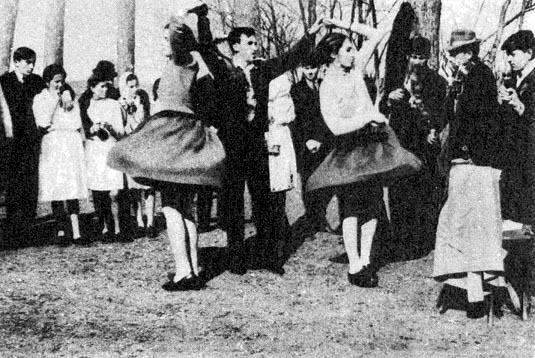
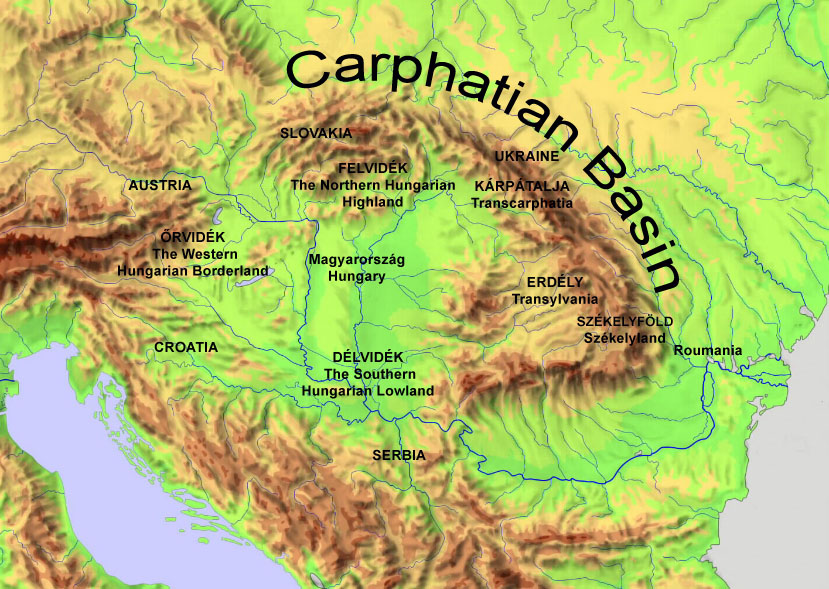
The name “csárdás” comes from the word “csárda,” which is an old fashioned Hungarian word for an inn. Csárdás is a traditional Hungarian folk-dance that evolved from the features of East-European pair dances that arrived in the Carpathian Basin during the European dance waves in the 19th century (mek.niif.hu)


Categorizing the different types of Csárdás is almost impossible because there are so many ways to group the types; for example, on the basis of the region of Hungary they danced it and the different subcategories of the geographical disposition in the given region, or even on the basis of how many people participate in the dance, and the ways it is structured. That is why I chose three categories to make you familiar with the possible differences in the framework of the same dance:

-         Hármas csárdás (hármas means triple): is the case when one man leads two women. It developed due to the shortage of men in the village (tudasbazis.suli.net)


-         Körcsárdás (kör means circle): here the pairs of dancers settle in a circle by grabbing each other’s hands, waist, or shoulders and perform some steps in this position, but later the circle breaks up and the pairs continue dancing in twos. (tudasbazis.suli.net)


-         Erdélyi csárdás (Csárdás of Transylvania): due to the ethnic situation of Transylvania, here Csárdás mixed with the features of dances from other cultures. For example, the rhythm may change into asymmetric or the speed may slow down. (tudasbazis.suli.net)

The details what one might think irrelevant make Csárdás unique. The clothes of the dancers are often the traditional costumes of the region with the folk embroidery on it. The men always show their musical knowledge by clapping their hands and flapping their boots to the rhythm. Meanwhile, women sing folksongs in chorus. 

The basic steps of Csárdás are really easy, two steps to the right and two steps to the left with a little bending of the knees while the ladies hands are on the shoulders of the men, and the men’s hands are on the scapula of the ladies. The difficult part comes with the really fast turns and the more complex steps, but for women it is easier because they do not have to master the flipping part.

However, I had had the opportunity both in elementary school and high school to learn Csárdás, but I have not tried it until my prom, when it was compulsory to dance it. This was a decision I regretted because it is true that Csárdás is not the type of dance that perfectly suits me, but while dancing I could feel my roots blooming out in me. Even if someone is not a Hungarian, experiencing the atmosphere of the culture is uplifting.